


At 007 Venture Partners, we are drawn to founders who build with conviction, clarity, and care. Not just building products, but building the infrastructure that decides who participates in the next technology transition, and who gets left describing it from the outside.
In robotics, a field where the binding constraint has quietly stopped being compute or model architecture and become something far more stubborn, we saw not just another AI data company, but a team solving a problem that every well-funded lab now faces: the training data for physical intelligence cannot simply be scraped. It has to be produced, by real people, wearing hardware, doing real work in real environments.
That is what Hub is here to build.
A New Kind of Data Infrastructure
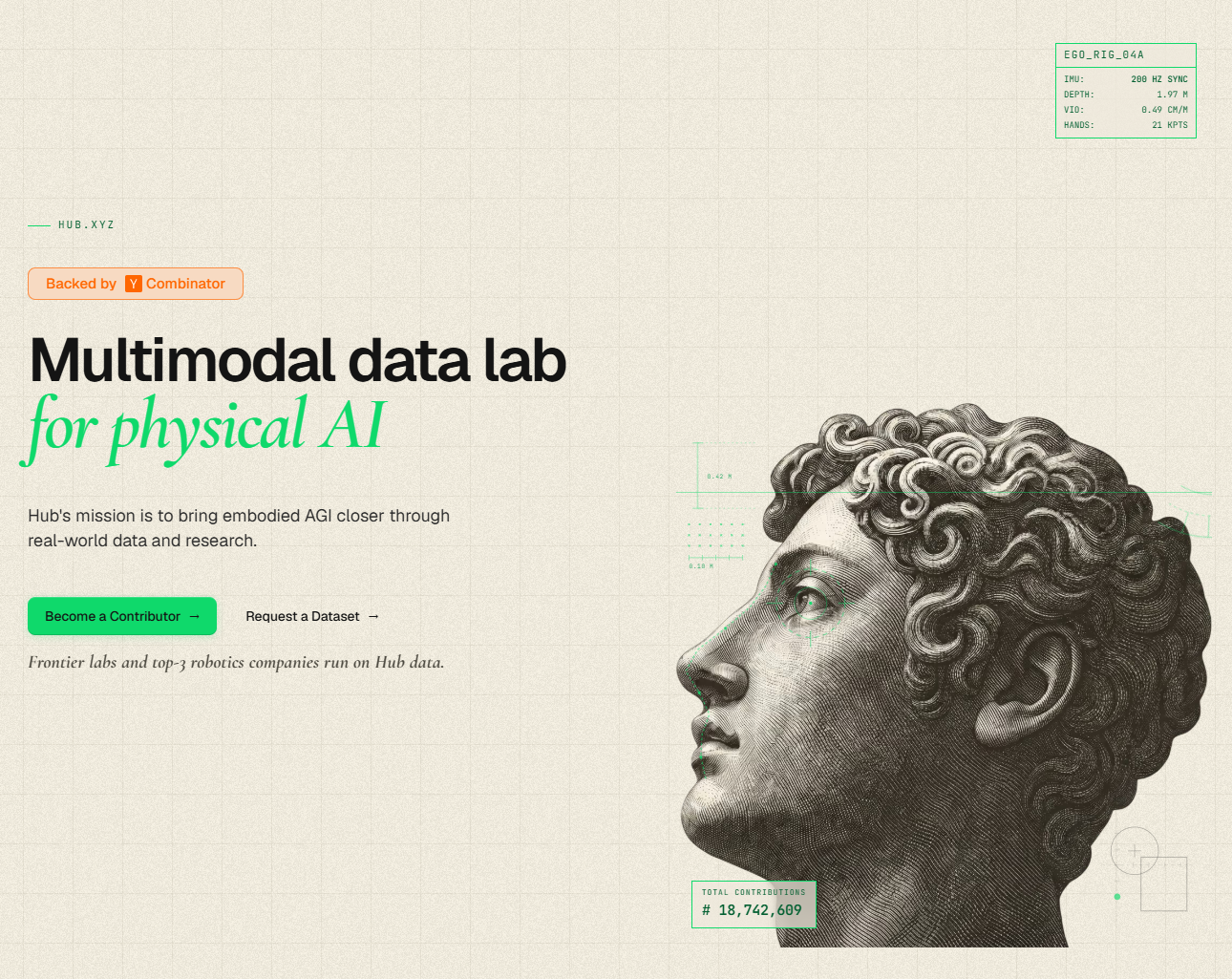
Hub is building what others have treated as someone else's problem: distributed human-data infrastructure for physical AI. It recruits, trains, equips and quality-assures a global contributor network that captures original egocentric, first-person video and other multimodal data to customer specification, then delivers that data to the frontier labs and robotics companies training embodied AI models, on an exclusive basis where exclusivity is required.
Hub's product is not a dataset. It is a specification-to-delivery pipeline: recruit, KYC, train, equip, ship, track, verify, deliver. That operating layer is assembled once and can then be re-pointed at a different customer, a different set of hardware, and a different brief.
The results are already speaking for themselves. Hub has crossed 10,000 verified production hours in a single 24-hour period. That milestone matters because it answers the first question. Human experience can be captured at meaningful scale.
From Egocentric Capture to the Human Layer of Robotics
Hub isn't just a collection vendor. The thing that convinced us was the shape of what it is actually building.
As demand for egocentric data has risen, the same footage can circulate across multiple labs, recycled, resold, or re-listed through intermediaries. For a buyer, contaminated data is worse than no data. It quietly introduces overlap with someone else's training set while inflating the apparent volume of genuinely new experience.
Hub's answer is structural. Data is collected against a defined customer specification and allocated through an auditable process. Where a customer requires exclusivity, Hub delivers exclusively rather than treating data as interchangeable inventory.
That distinction matters. Hub is not simply selling hours. It is selling confidence about where those hours came from, who they were collected for, and whether the resulting dataset will stand up to scrutiny.
And capture is only the beginning.
The same operational infrastructure Hub is building today, recruiting, training, equipping, verifying and coordinating people at scale, is the foundation for the next layers of physical AI infrastructure. As robotics systems mature, Hub is building toward robot teleoperation, embodiment-specific demonstrations and corrections, and eventually remote fleet operations and assurance.
That is a layer Hub is building toward, not an automatic transition for every contributor. Not everyone who records video needs to become a teleoperator. The point is that the network and the operating capability can support increasingly specialised forms of human interaction with robots as the market develops.
The data changes. The network compounds.
Why Now
The macro environment has never been more aligned for what Hub is building, and the evidence is increasingly public.
In August 2026, Dyna Robotics released Dyna-2, a world-action model pretrained on more than one million hours of human video. Its research sets out scaling relationships between human video and downstream robot performance, including what Dyna describes as a human-to-robot transfer scaling law. Those downstream results were measured after the pretrained model was post-trained on robot data, so human video is not a substitute for robot demonstrations. It is the substrate that makes the robot-specific training that follows more effective. The implication is still significant: added human experience at the pretraining stage can translate into measurable improvement in models operating across embodiments.
Skild AI's S1 points in a complementary direction, using in-context learning to let a robotics model take a human demonstration and perform a task it has not seen before. As models grow more capable, demonstration data becomes more valuable rather than less.
NVIDIA's EgoScale examines how scaling egocentric human experience improves robot learning. EgoMimic, from researchers at Georgia Tech and Stanford, demonstrates the value of egocentric human video for imitation learning.
Taken together, these lines of research sharpen the opportunity. Human experience is becoming a core substrate for physical intelligence, and producing high-quality, provenance-rich, task-specific human experience at scale remains an operational problem rather than a modelling one.
That is precisely the layer Hub is building.
Neutrality matters at the same moment. As the robotics-data market matures, customers care not only about volume and quality but about provenance, independence, and who ultimately controls the pipeline their training data flows through. A trusted, independent infrastructure layer becomes more valuable as the datasets themselves become more strategically important.
The Founding Team
The best founding teams are the ones assembled around the actual shape of the problem. Hub's is exactly that.
Tim Sprecher, COO and co-founder, scaled a medical e-commerce business to seven-figure revenue at nineteen and owns data collection, sourcing and logistics. This is the least glamorous part of the business and the part that determines whether the vision can actually be executed. Hub has to put the right hardware in the hands of the right people across multiple countries and environments, and reliably turn that activity into verified data. Physical-goods operating experience matters more here than it looks.
Armin Kiani, CEO and co-founder, brings a computer science and robotics background and won Brussels' Microsoft Innovation Award in 2020. He previously worked at Freedelity, Belgium's largest consumer-data platform, which is directly relevant experience in consented, rights-cleared data collection at population scale. That matters enormously here: the value of Hub's product rests on provenance being clean, auditable and defensible.
Hub is an operations company wearing an infrastructure label. Its defensibility is not a model or an algorithm. It is the ability to reliably put the right hardware on the right person in the right environment and get verified footage back against a defined customer specification. That is an operating competence, and this team is built around it.
Why We Invested
At 007VP, we invest in founders solving hard problems at scale, especially those building infrastructure that routes opportunity toward the people existing systems overlook.
Hub fits that mission precisely. It is building the supply layer for one of the most heavily funded technical problems in the world, at the precise moment the importance of physical-world data is becoming clear.
The moat is operational and compounding rather than algorithmic, which is unglamorous but correct for this business. Every contributor recruited, trained, equipped and quality-assured makes the network more capable and raises the cost of the next entrant. Every new customer specification tests and strengthens the operating system. Every delivered dataset adds to the institutional knowledge around provenance, quality and distributed collection.
We are proud to back Tim, Armin and the Hub team as they build that infrastructure.
The Road Ahead
The sharpest version of Hub's vision is not that robotics data disappears as models improve. It is that the scarce unit changes.
Today the bottleneck is diverse, task-rich human experience: people interacting with the physical world across different environments, objects, cultures and ways of doing things.
As models improve, the need shifts toward robot-specific demonstrations and corrections, the data that closes the gap between general human experience and the behaviour of a particular machine.
Eventually the scarce resource becomes more specialised still: rare failures, edge cases, and evidence from robots operating in the real world at fleet scale.
Robotics data does not disappear. Its form evolves. Hub is building the operating layer across that progression.
Its impact profile is unusually structural, because the same mechanism that generates returns generates the impact. The model routes frontier-lab capital directly to individuals in emerging markets in exchange for skilled work, with hardware provided at Hub's cost, KYC verification, and payment infrastructure behind it. Contributors participate by recording tasks in their existing environments, without being asked to give up existing work to take part.
There is a less obvious argument, and it may be the more important one. Robot foundation models trained predominantly on North American and European household data will encode North American and European kitchens, tools, layouts and practices, and they risk underperforming everywhere else.
Hub's distributed network across LATAM and beyond pushes geographic and cultural diversity into the training substrate of embodied AI, at the exact moment that substrate is being laid down. Diversity is not simply a feature of the supply network. It becomes part of the quality of the resulting intelligence.
The longer-term opportunity extends beyond capture. As robots become more capable and commercially deployed, Hub can build toward increasingly specialised human-robot interaction, from demonstrations and corrections through to teleoperation, remote assistance, and eventually fleet operations and assurance.
The mission aligns closely with UN Sustainable Development Goals 8, 9, 10 and 17, and sits at the intersection of decent work, AI infrastructure, and who gets represented in the systems being built right now.
As the team scales its network, converts its pilots into production relationships, and builds toward the next layers of the human-robot interface, we are proud to support Tim, Armin and the Hub team on this journey.
Because when robots learn how the world actually works, it matters enormously whose world they learned it from.


