
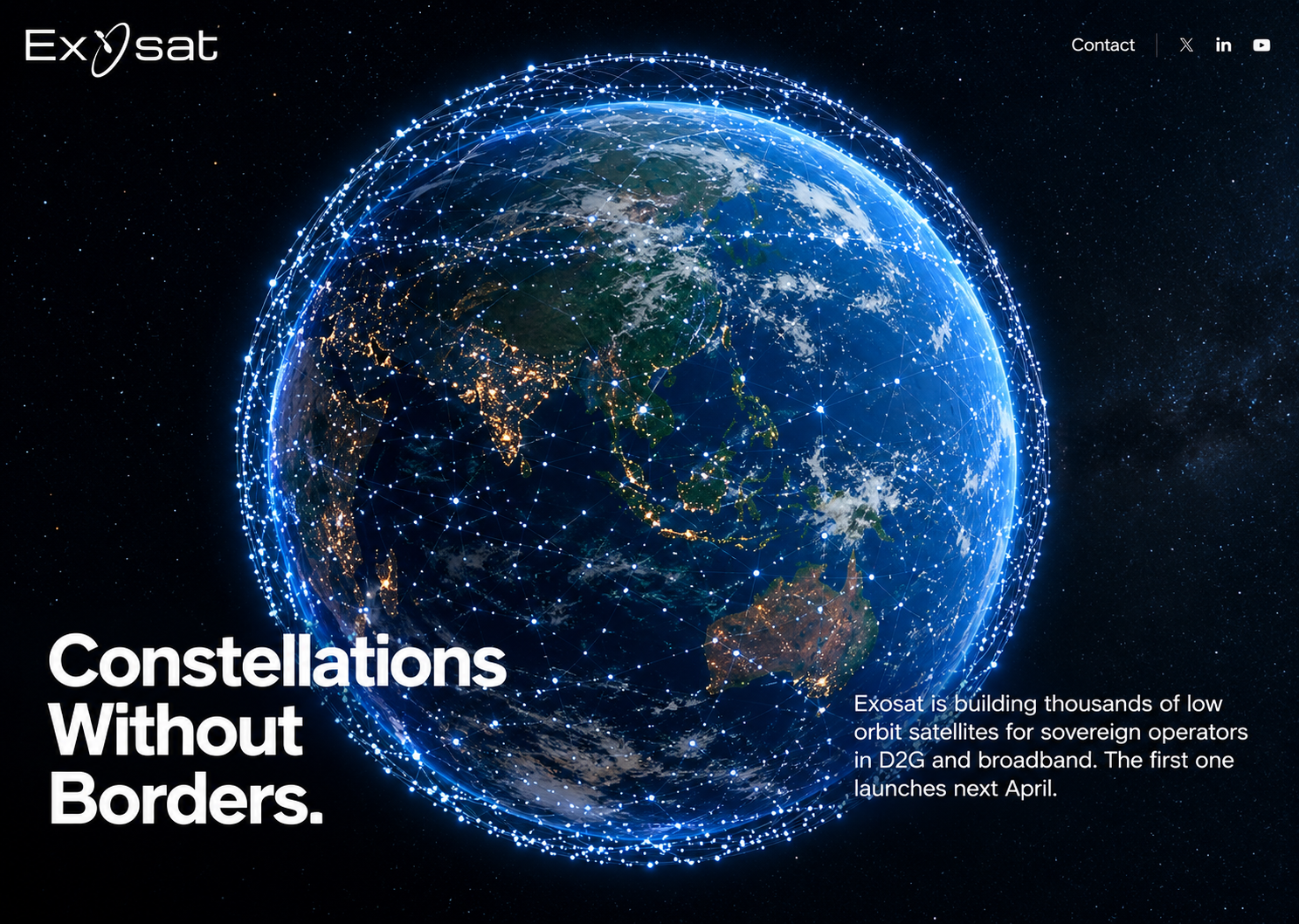


At 007 Venture Partners, we are drawn to founders who build with conviction, clarity, and care. Not just building products, but expanding access, sovereignty, and self-determination for the countries and communities that existing infrastructure overlooks.
Satellite connectivity has quietly become national critical infrastructure. It carries emergency communications, maritime and aviation traffic, rural broadband, defence networks, and the backhaul that holds the internet together where fibre does not reach. And today, almost all of it is controlled by two powers.
That is not a theoretical concern. Starlink service was cut off during Ukrainian operations. India paused Starlink's rollout pending a sovereignty review. Indonesian telcos lobbied to restrict it. European telecom leaders have publicly warned about US dominance in satellites. Nations and enterprises are increasingly wary of staking critical communications on infrastructure owned by a foreign superpower, and the alternatives outside the US and China are slow, expensive, or both.
That is what Exosat is here to fix. We are proud to share that 007 Venture Partners has invested in Exosat, a Singapore-headquartered company building a neutral, sovereign low-earth-orbit satellite constellation, and the first YC-backed space company based outside the Western world.
A New Kind of Satellite Operator
For Exosat, neutrality is the product, not a feature.
The company is domiciled in Singapore and operates under an explicit policy of not entering the US or Chinese domestic markets and not selling to either country's military. Its ground segment is designed so that user traffic lands in in-country gateways, with no mirroring or storage abroad, ground-only telemetry and control from local sites where a government requires it, and an optical inter-satellite link policy-routed to carry no local user traffic.
These are structural choices, not marketing positions. A US or Chinese operator cannot copy them without undermining its own position at home. That is the gap Exosat is built to occupy: a credible third option for buyers who do not trust US access guarantees and do not trust Chinese state infrastructure either.
Where a nation wants more, the architecture extends: local manufacturing, local launch, local gateways, and routing that complies with national rules. A sovereign constellation a country can actually hold.
The Cost and Coverage Thesis
A conventional LEO communications satellite costs around $5M. Exosat targets roughly $320K at 100 units.
The insight behind that gap is physical. By flying at or below 500km, where the radiation environment is mild, Exosat can build from automotive-grade components rather than radiation-hardened ones. It designs with zero ITAR or EAR-controlled parts, using radiation-tolerant FPGAs with triple modular redundancy and non-ITAR baseband processors. The trade-off is a shorter satellite life of three to five years, which the company treats the way Starlink does: as faster hardware refresh cycles rather than a defect.
The export-control-free bill of materials is itself a strategic asset. It lets Exosat launch on almost any vehicle, including non-US rockets and equatorial spaceports, and it unlocks sovereign manufacturing in places like Bangalore that US operators cannot offer at any price.
Then geography compounds the advantage. Exosat's customers sit mostly along the equator, and management estimates each satellite delivers four to five times more useful coverage time over them than a high-latitude Starlink satellite. Cheaper satellites, and fewer of them needed to serve the same market.
From Connectivity to Orbital Infrastructure
Exosat is not only a satellite internet company. The roadmap is sequenced so that each stage funds the next.
Satellite IoT comes first, from late 2027. Store-and-forward packet delivery for agriculture, logistics, energy and maritime customers across Southeast Asia, Latin America and Africa does not need continuous coverage, which means Exosat can generate revenue from a sparse constellation long before the full network exists. First deals are structured as upfront financing plus revenue share with local partners, which shifts part of the constellation capex off Exosat's balance sheet.
Direct-to-cell and telco capacity follow from 2028. Cellular connectivity to unmodified smartphones under 3GPP NTN Release 17 and 18, sold to telcos in markets where Starlink or AST cannot land spectrum, and to Asian handset makers shipping satellite-capable devices into the Global South.
Broadband and orbital compute come from 2029. Full LEO broadband as launch capacity scales, plus edge inference on the satellites themselves for maritime, rural, robotics and autonomous-vehicle use cases, using a dawn-dusk shell as a compute backbone.
That last line is where the opportunity stops looking like telecoms and starts looking like infrastructure. The same constellation that carries a farmer's sensor data becomes the compute layer nearest to everything that moves.
Why Now
Starlink has already proved how valuable this layer is. It generated $11.4B in revenue in 2025, up roughly 50% year on year, with $4.4B in operating income, and it crossed 12 million subscribers across more than 160 countries in June 2026. It is the profitable core of a company that listed on Nasdaq at a ~$1.75T valuation. Owning the satellite connectivity layer turns out to be one of the best businesses in telecommunications.
The prize is clear. What is not available is a neutral version of it.
The alternatives are constrained in ways that are structural rather than temporary. Amazon Leo slipped around 14 months after the May 2026 pad explosion. OneWeb lost roughly three years to its 2020 bankruptcy and was recapitalised with European state backing. AST SpaceMobile's service start is about four years behind its original 2023 target. Chinese state constellations struggle to secure landing rights and trust abroad. Every one of these is also domiciled in a country that some sovereign buyers will not accept.
Meanwhile the market is growing into the gap. Novaspace and Euroconsult project commercial satcom services growing from ~$18B in 2024 to ~$32B by 2033, driven by LEO and direct-to-device. Sovereign satellite connectivity specifically is projected to grow from $9.4B in 2025 to $40.2B by 2034. Adjacent sovereign markets are larger still: sovereign cloud from $117.5B to $648.9B by 2033, and sovereign AI infrastructure from $28B in 2026 to $301.6B by 2035.
A credible third option outside the US and China does not yet exist. That is the whole opportunity, and the window for claiming it is defined by orbital shells and spectrum filings, both of which are finite.
The Founder
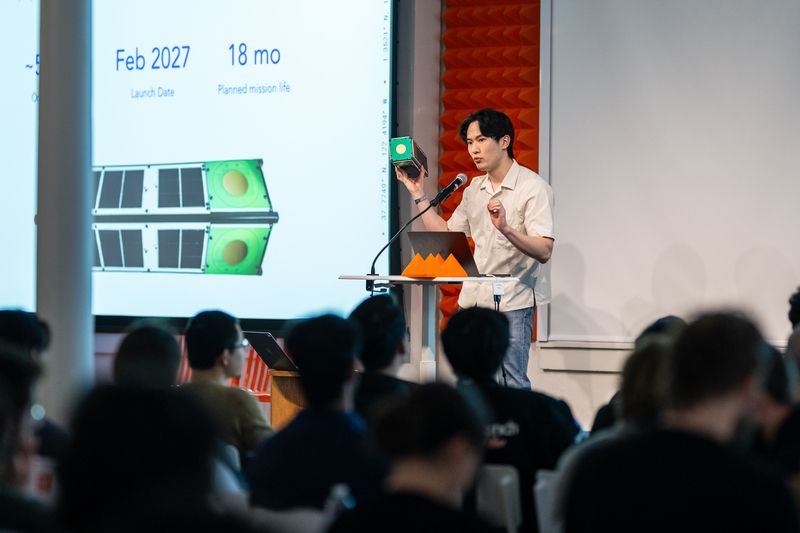
The best founder stories are the ones where the person has already done the hard part once. Edward Ge has done it twice.
Before Exosat, Ed founded and led Aethero from 2022 to 2026, building space-grade edge computers. He scaled it to millions in revenue with customers including Blue Origin, the Air Force Research Laboratory and defence primes. He flew the first NVIDIA Orin GPU in orbit and ran hundreds of hours of on-orbit testing on NVIDIA hardware. He launched a second satellite, Phobos, with Booz Allen Hamilton in early 2026, and conducted radiation-hardening research with AFRL and The Aerospace Corporation. Earlier, while at the University of Missouri, he founded Stratodyne, a high-altitude balloon platform.
Then he turned down an acquisition offer for Aethero to start something harder.
He moved to Singapore. He hand-built Exosat's first prototype, including in-house phased arrays and no US-origin parts, in a fume-hood clean room in his apartment. And he paid the deposit on the first launch slot out of his own savings.
That conviction is rare. In a capital-intensive, execution-heavy category where most companies die in the gap between a good deck and working hardware, prior flight heritage and personal capital at risk are among the strongest signals available at seed.
Why We Invested
At 007VP, we invest in founders solving hard problems at scale, especially those building infrastructure for the people and places existing systems overlook.
Exosat fits that mission precisely. But what moved us from interest to conviction was velocity. Within roughly 90 days of incorporation, the company filed an 11,000-satellite, four-shell constellation with the ITU across S, L, Ka and C-band: the largest filing outside the US and China, and priority-dated. Filing a constellation is not the same as building one, but it is the gate everything else has to pass through, and most companies take years to reach it.
What has followed since:
- $500M+ in signed letters of intent across six markets in Southeast Asia, Central Asia and the Middle East
- First launch booked and paid on SpaceX's Bandwagon-6 for April 2027, to test the software-defined radios the direct-to-cell product depends on
- Spectrum landing rights in progress across 10 nations in Africa, Latin America and Southeast Asia
- A working prototype with in-house phased arrays and no US-origin parts
We are proud to invest alongside Y Combinator, Pioneer Fund, Orange Collective, Robinhood Ventures, Hustle Fund, Paul Graham, and early investors in SpaceX and Anduril.
The Road Ahead
The path from here is unusually legible, which is rare for a space company.
A single prototype launches on Bandwagon-6 in April 2027 to validate the radios. Twelve to twenty satellites in orbit by 2028 carry the first IoT revenue. Thirty to five hundred satellites across 2029 to 2031 bring direct-to-cell and broadband, with Gen 2 production targeting 200 satellites a year from Bangalore by 2031. Full four-shell deployment follows from 2032.
The platform also carries deep impact credentials. Exosat's mission aligns with UN Sustainable Development Goals 9, 10, 13 and 17. The company is explicitly focused on the roughly 6 billion people outside the US and China, including rural and remote communities that terrestrial networks will never reach economically. Satellite IoT enables environmental monitoring, agriculture and disaster early warning where there is no ground coverage. Direct-to-cell keeps phones connected when terrestrial networks fail. Local manufacturing, in-country gateways and revenue-share partnerships keep ownership and control with host nations rather than extracting it. Satellites are designed to deorbit within five years of end of mission under IADC norms.
As the team converts its LOIs, adds technical leadership, and works toward next April, we are proud to support Ed and the Exosat team on this journey.
Because when a country can run its own critical communications on infrastructure it actually controls, you do not just add a connectivity option. You change what sovereignty means in an era where the network is the territory.
And that is what Exosat is building.


