



At 007 Venture Partners, we are drawn to founders who build with conviction, clarity, and care. Not just building products, but giving people better visibility into their own health, and moving healthcare from guesswork towards something personal and preventative.
Start with what most people get when they buy a probiotic. A bottle of standard strains, made in the same formula for millions of people, with no way of knowing whether any of it works. The global probiotics market was worth around $77B in 2025. Yet fewer than 5% of the strains in a typical off-the-shelf probiotic go on to colonise the gut. Most of what people take passes straight through.
The problem is not that probiotics can't work. Every gut is different, and the industry has kept selling the same product to all of them.
Where It Started
GutGutGoose began with Leon's own gut problems. While searching for something that worked, he found a gap at the centre of a global industry. After decades of growth, probiotics were still marketed as a one-size-fits-all solution, even though no two guts are the same.
"We wanted to help as many people as possible with probiotics, as most of the current options were far from being highly effective," said Anis.
That is what GutGutGoose is here to fix. We are proud to share that 007 Venture Partners has invested in GutGutGoose (YC S26), a San Francisco-based company that sequences your gut microbiome and engineers the exact probiotic it needs.
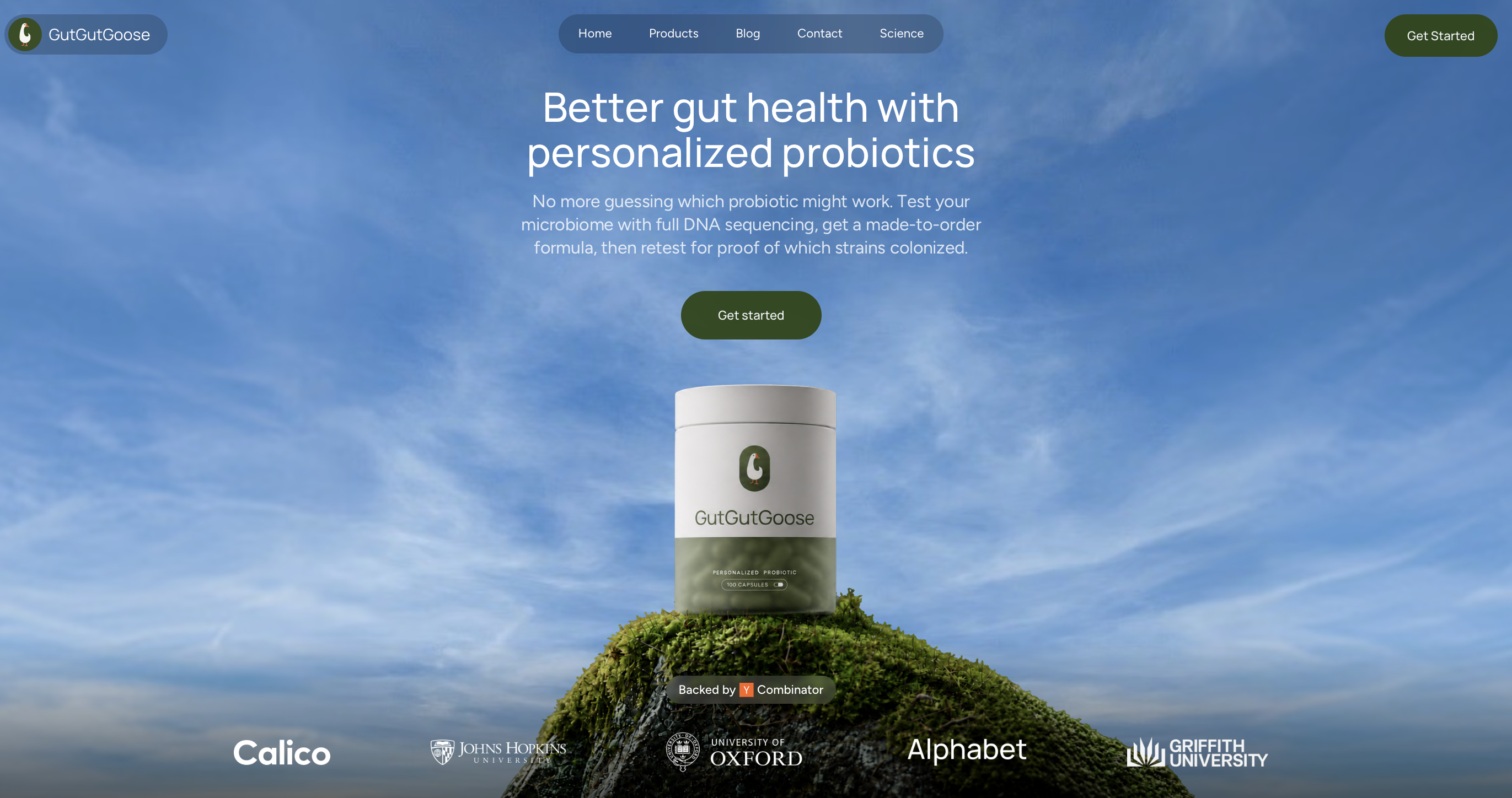
A New Kind of Probiotic
For GutGutGoose, personalisation is the product, not a marketing claim.
It runs as a 90-day cycle:
- Sequence: an at-home kit and a single stool sample, analysed with shotgun metagenomic sequencing
- Model: more than 300 candidate strains tested virtually against the customer's own gut before anything is made
- Review: a bioinformatician and/or pharmacologist checks every report before compounding
- Formulate: a custom weekly pill of 4–12 strains, made by a compounding pharmacy
- Recalibrate: the customer is re-tested every 90 days to confirm what established, and the formula is adjusted
The last step is what makes this different. Every customer is re-measured, so the product has to prove itself, person by person. It comes with a money-back guarantee if it doesn't.
Education matters as much as the pill. Every customer gets a report explaining what is in their gut and what it means for them, and premium customers walk through their results one-on-one with an expert. The aim is to help people understand the complex biology behind how they feel, and give them a sense of control over their own bodies.
Why Colonisation Is the Whole Game
A probiotic only does its job if the strains establish in the gut. That is the number GutGutGoose is built around.
The engine is built on peer-reviewed metabolic modelling frameworks (MICOM and AGORA2), drawing on more than 7,000 bacterial metabolic reconstructions. On published research cohorts, its predictions matched what actually established 84.7% and 76.7% of the time. The company's own internal reproduction came in at 78.1%.
In customers, 83% of GutGutGoose strains colonise the gut, compared with under 5% for generic probiotics. That is roughly 16 times better, and the company describes the result as comparable to a faecal transplant.
From Probiotics to a Model of the Human Gut
What excites us most is where this could go beyond the product.
Every 90-day cycle produces three things: a baseline, an intervention and an outcome. Repeated across thousands of customers, that becomes something rare in microbiome science. Most datasets are one-off snapshots. GutGutGoose is building a longitudinal record of how the human gut responds to controlled changes over time.
"Long term, we want to build a dataset that helps improve understanding of how the microbiome changes over time and how that relates to health," said Leon. "Success for us would be giving people better visibility into what's happening inside their own gut and helping move healthcare towards more personalised and preventative approaches."
The team is using that data to work towards a foundation model of the human gut. The first focus is detecting early signatures of Parkinson's, with the longer-term hope of contributing to research on early markers of Alzheimer's disease and dementia. GutGutGoose offers its service free to patients with Parkinson's, Alzheimer's and dementia to support that research, and has made a clear commitment: it does not sell customer data, and never will.
Read in order, that is a story about visibility rather than supplements. A person with years of gut problems finally sees what is happening inside them. A customer can measure whether their intervention worked. And over time, researchers gain a new window into how the gut relates to some of the hardest diseases we face.
Why Now
In 2010, shotgun metagenomic sequencing cost around $10,000 per sample. Today it is affordable enough to offer to consumers. Metabolic modelling of the gut, until recently confined to academic labs, can now be run for every customer. And consumers are already paying for wearables, blood panels and microbiome tests, while increasingly asking for proof that what they take is working.
The demand is clear. What has been missing is a product that tests, intervenes and measures in one loop. GutGutGoose sits in that gap.
The Founders
Leon Mojarrabi and Anis Mihrshahi are childhood friends who both started university at 14.
Before GutGutGoose, Leon spent four years at Go1, a YC company valued at around $3B, where he managed around $100M in lead-to-cash as its go-to-market engineer. Then he did something unusual: he built a pharmacy to around $4M in annual revenue within six months, and used it to fund the early science behind GutGutGoose. He also went through the treatment himself to deal with his own gut problems.
Anis is the youngest-ever Queensland Math Olympiad champion. He gave up a Chancellor's Excellence Scholarship in AI and Data Science to work on GutGutGoose full-time, co-built the prediction model and runs operations.
Between them, they cover what this company needs: pharmacy, compounding and commercial operations on one side, and the AI and computational biology behind the engine on the other. That combination, and the conviction behind it, is rare.
Why We Invested
GutGutGoose fits that mission. But what moved us from interest to conviction was velocity. In the weeks after launch:
- Demand quickly outpaced capacity, with a waitlist that grew faster than the team could onboard
- Paying customers came on board from the very first cohort, and the business is already funding its own growth
- 83% of strains colonise the gut, compared with under 5% for generic probiotics, and every customer is re-tested to confirm it
It is rare to see a consumer health company find this kind of pull so early. It is rarer still when the product is built to show each customer whether it worked.
We are proud to invest alongside Y Combinator and Paul Graham.
The Road Ahead
The next 12 months are clear. The team plans to bring thousands of customers through from the waitlist, publish research on outcomes, and move towards a peer-reviewed disease-detection model, most likely for Parkinson's. Along the way, they expect to build the largest longitudinal gut intervention dataset of its kind.
The company's mission also aligns with UN Sustainable Development Goals 3 and 9. It gives people with chronic gut problems a personalised intervention they can measure and understand. It offers free access to patients with neurodegenerative disease to support research. And it is building a dataset and model of the human gut that could become new scientific infrastructure for researchers and clinicians.
We are proud to support Leon, Anis and the GutGutGoose team on this journey.
Because when people can see what is happening inside their own gut, and measure whether what they take is working, you don't just make a better probiotic. You change what personal healthcare can look like.
And that is what GutGutGoose is building.


