
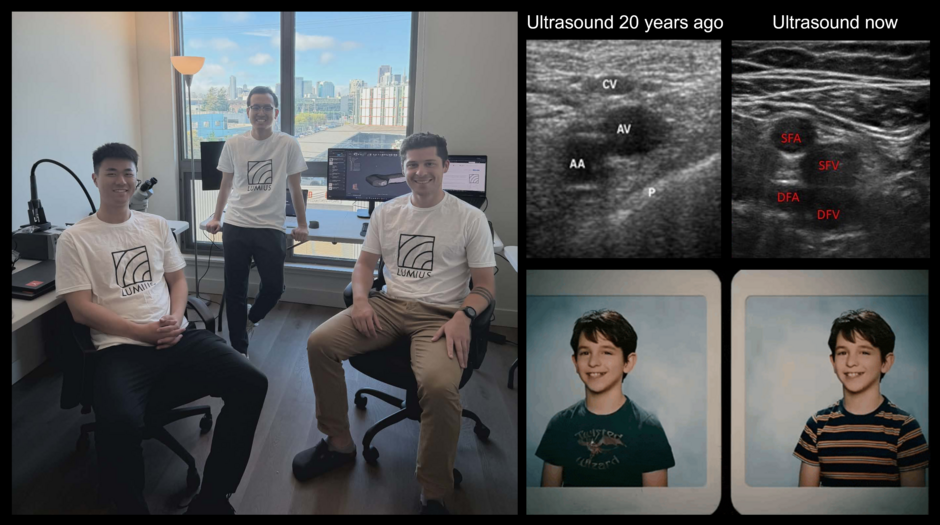


At 007 Venture Partners, we are drawn to founders who build with conviction, clarity, and care. Not just building products, but expanding what's possible at the bedside, in the operating room, and everywhere a clinician's hands and eyes are asked to do more than human perception allows.
In a healthcare system where ultrasound is performed roughly 500 million times a year, yet has remained fundamentally two-dimensional for decades, we saw not just another medical imaging company, but a team solving the problem every incumbent had the tools to fix and never did: what happens when a clinician has to mentally reconstruct a 3D body from a flat slice, in real time, with a patient's life on the line.
That's what Lumius Imaging is here to fix.

A New Kind of Ultrasound
Lumius is building what others were too capital-intensive to attempt: a real-time, accessible 3D ultrasound system that turns a standard, off-the-shelf 2D probe into something closer to a 3D camera for the body. Not 3D as in "if you can afford a $400,000 cart." But 3D as in: real-time, radically cheaper, and built from the ground up for the clinicians who need it most, at the bedside, not just in the radiology suite.
Instead of forcing clinicians to spend weeks and more than 30 procedures learning to mentally translate 2D slices into 3D anatomy, and still face only a 50% first-attempt success rate on something as routine as central venous catheterization, Lumius gives them real-time 3D volumes from the same linear-array transducer they already own, at roughly a tenth of the cost of existing 3D systems.
The science isn't a pitch deck claim. It's published. The underlying diffractive acoustic tomography architecture appeared in Nature Communications in January 2025, demonstrating near-isotropic 3D resolution and a 50-fold improvement in reconstruction speed, validated across phantom, small-animal, and translational studies. Not a marginal improvement. A structurally different approach to a problem the field had treated as unsolvable at this price point.
From Imaging Hardware to a Voice-of-the-Body Platform
Lumius isn't just a cheaper 3D ultrasound machine. The platform pairs its imaging core with a proprietary AI-assisted, mixed-reality visualization layer, patent filed, that overlays segmented 3D anatomy directly onto the patient's body through an MR headset. That layer is what turns weeks of training into minutes of competency, removing the single biggest barrier to adoption for 3D-guided procedures.
The cost structure matters enormously. An estimated $5,000 COGS against a $30,000 target price undercuts high-end 3D incumbents by roughly 13x, while still leaving healthy hardware margin. Every deployment strengthens a two-layer IP moat, the foundational Duke University patent estate on the hardware side, and Lumius's own provisional patent on the AI/MR interpretability layer, that neither cart-based 3D incumbents nor handheld 2D players can easily replicate.
And the central-line wedge is only the beginning. The same platform extends to peripheral IV, arterial line, biopsy, anesthesia, robotic guidance, and eventually embedded sensing inside surgical robots and wearable, at-home fetal monitoring. The combined direct-replacement market already exceeds $46B. Lumius is starting with a procedural safety problem and building toward the foundational 3D sensing layer for an expanding set of industries beyond ultrasound itself.
Why Now
The macro environment has never been more aligned for what Lumius is building.
Ultrasound has not materially improved in 20 years, even as it remains one of the highest-volume imaging modalities in medicine. The populations and procedures that need 3D guidance are growing faster than the installed base of $400,000 systems can reach. The dominant incumbent path, capital-equipment 3D ultrasound, costs hospitals hundreds of thousands of dollars per unit, takes weeks to learn, and has not closed the cost or usability gap in a generation.
Meanwhile, AI-assisted visualization has only recently become good enough, and cheap enough, to make real-time mixed-reality guidance viable at the point of care. Lumius is the only team we've seen combining a peer-reviewed, structurally different 3D imaging architecture with a usability layer that collapses time-to-competency from weeks to minutes.
The traditional incumbents, Philips, GE, and the handheld 2D players like Butterfly Network and Clarius, remain structurally unable to solve cost, true 3D capability, and usability simultaneously, because doing so means rebuilding their underlying imaging architecture from scratch. That gap is Lumius's opening, and it is widening.
The Founders
The best founder stories are the ones where the team didn't just study the problem, they invented the physics that solves it.
Tri Vu, PhD, CEO, - Duke PhD in biomedical engineering, former professor at University of Oklahoma, and Philips Ultrasound engineer intern. A rare combination of academic leadership and industry execution. He is a co-inventor on the foundational Duke patent estate and a named author on the Nature Communications paper underlying Lumius's core technology.
Luca Menozzi, PhD, CTO, invented the core 3D-DAT imaging technology while at Duke, and is first/co-first author on the Nature Communications publication. He's a named inventor on both the foundational Duke patent estate and Lumius's own mixed-reality provisional patent, the rare technical founder who built the science before he built the company around it.
Chenhang Li, PhD, COO, invented wearable ultrasound elastography and trained in mechanical engineering and materials science at Duke and Northwestern. She is a named inventor on Lumius's mixed-reality visualization patent application, rounding out a team where the people who invented the technology are the same people commercializing it.
Together, the team brings roughly 2,500 citations, 50+ peer-reviewed papers, 20 years of combined ultrasound R&D experience, and 4 pending patents, with work published in Science, Science Advances, PNAS, Cell Stem Cell, Nature Biotechnology, and Nature Communications. This is not a team theorizing about an imaging problem. They are the people who solved it on the research bench, and are now building the product that brings it to the bedside.
Why We Invested
At 007VP, we invest in founders solving hard, physical problems at scale, especially those building infrastructure for the clinicians and patients underserved by capital-intensive incumbents.
Lumius fits that mission precisely. It's a capital-efficient, peer-reviewed, founder-owned technology company targeting a market gated by cost and usability, not by any lack of clinical need. A working MVP and a functioning AI-assisted MR prototype, built within roughly seven weeks of joining Y Combinator, is exceptional engineering velocity for a hardware-plus-AI company at this stage. $370K in non-dilutive ARPA-H subcontract funding and $5.7M in signed LOIs, achieved before the device has completed formal development, is a strong signal of pull from both research and commercial channels. And the pipeline includes some of the most credible names in surgical robotics and medical devices.
We are proud to invest alongside FundersClub, Boost VC, Robinhood Ventures, Vento Ventures, and Y Combinator.
But more than the metrics and the cap table, we believe in what Tri, Luca, and Chenhang stand for.
We believe every clinician, not just the ones with access to a $400,000 capital-equipment suite, deserves the ability to see in 3D what they are doing inside a patient's body. We believe a peer-reviewed technology that cuts time-to-competency from weeks to minutes, at a fraction of the cost of existing 3D systems, is not a marginal improvement but a genuine step change in procedural safety.
The Road Ahead
The vision is bold. The execution so far has been even bolder.
With a Q-sub FDA meeting in Q3 2026, a completed device and early research-lab launch by Q4 2026, a superiority study against 2D ultrasound in Q1 2027, and a clear path to 510(k) clearance and clinical launch by Q1 2028, Lumius is positioned to define the category of accessible 3D imaging for the next decade.
The platform also carries deep impact credentials. Procedural complications from 2D-guided vascular access, only a 50% first-attempt success rate, with a six-fold increase in complications after a failed attempt, are a meaningful and preventable source of patient harm. Lumius removes the cost and skill barriers that have kept 3D guidance out of community clinics, rural providers, and resource-constrained health systems, making the standard of procedural visualization available to the patients who today cannot access it at all. The mission aligns closely with UN Sustainable Development Goals 3, 9, 10, and 17, and sits at the intersection of medical device innovation, health equity, and AI-native infrastructure.
As the team advances toward FDA clearance, deepens its commercial pipeline, and builds toward the broader 3D sensing opportunity, we are proud to support Tri, Luca, Chenhang, and the Lumius team on this journey.
Because when you give a clinician the ability to see in three dimensions for the first time, you don't just improve a single procedure. You change what's possible at every point of care.
And that's what Lumius Imaging does.


